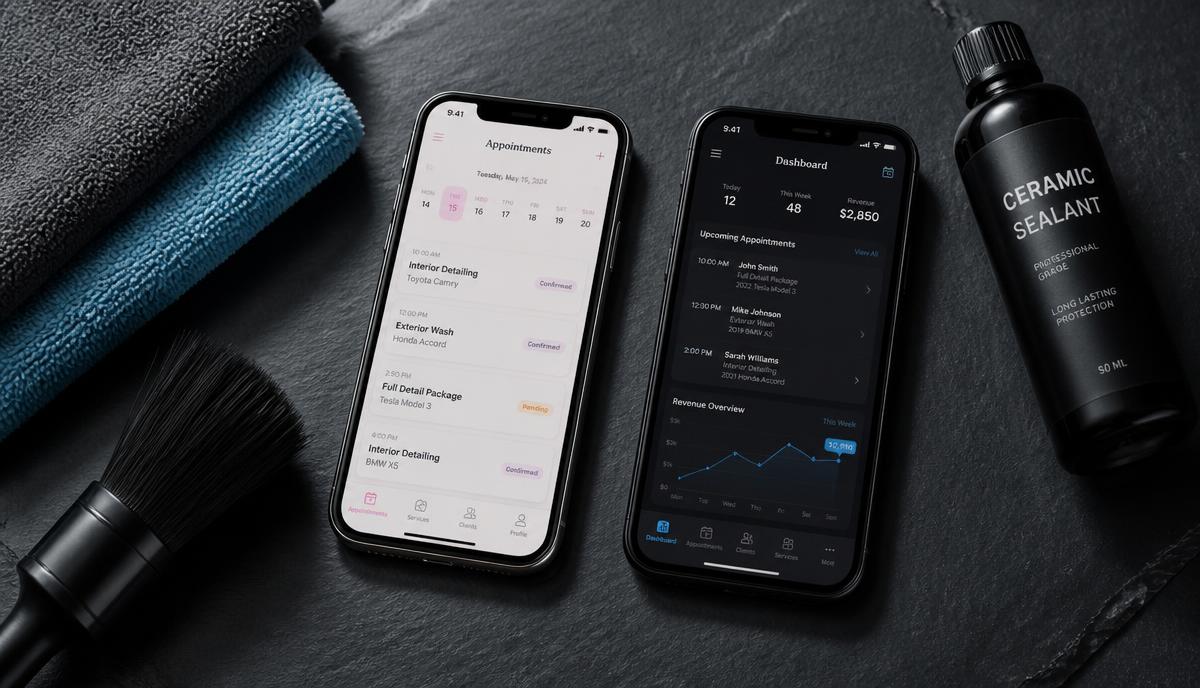
Most mobile detailers pick a booking system the same way most people pick car insurance. They search for something cheap, sign up for the first one that looks reasonable, and never look at it again until it breaks or starts costing them money.
Then it does both.
At Automate, we work with mobile detailers and valeters across the UK every day. We've seen the full spectrum. Detailers running hundred-grand-a-year operations from a paper diary. Detailers paying £80 a month for software built for American barbers. Detailers still replying to WhatsApp messages at eleven at night because they haven't figured out there's another way.
This guide is written for anyone in the UK detailing industry who's about to pick a booking system, or who's suspecting the one they're on isn't quite right. It's not a list of our top five tools. It's a checklist of the features and qualities that actually matter, so you can work it out yourself.
The real cost of the wrong choice
A booking system is one of the lowest-cost, highest-leverage decisions a mobile detailer makes. It touches every customer you have. Every quote. Every confirmation. Every payment. Every review. It's the spine of how your business runs.
Which means when it's wrong, it's not a small problem. It's a quiet, compounding tax on your time and your revenue.
Lose one booking a week because a customer couldn't work out how to book with you online and couldn't be bothered to call. That's fifty bookings a year. At an average ticket of sixty to a hundred and twenty pounds, that's three to six thousand pounds of revenue you never saw walk through the door.
Miss one chance a week to collect a review because your system doesn't ask automatically. That's fifty Google reviews you didn't get this year. Local search rankings are built on review volume and recency. Over twelve months, that gap compounds into a measurable ranking loss, which compounds into fewer enquiries, which compounds into slower growth.
The cheapest booking system in the world is expensive if it costs you bookings.
One lost booking a week is three to six thousand pounds a year. One missing review a week is a measurable hit to your local search ranking. The wrong booking system doesn't cost you £30 a month. It costs you everything the right one would have unlocked.
When you probably don't need a booking system yet
Worth saying up front, because it's honest and because most buyer's guides won't.
If you're doing fewer than five jobs a week, your entire customer base is repeat locals who know you personally, and you're happy with the volume you've got, you probably don't need a booking system. A paper diary and a WhatsApp thread will see you through.
The moment that stops being true is usually predictable. New customer enquiries outnumber existing ones. Evenings disappear into replying to messages. A no-show costs you a full morning because you drove thirty miles and the customer forgot. You start missing things.
If any of that sounds familiar, you've passed the point where a diary is enough. The rest of this guide is for you.
The three types of tool you'll encounter
Before we get into the checklist, it helps to know what's actually on the market. Broadly, there are three categories of booking system a mobile detailer will come across, and they serve very different jobs.
Generic appointment scheduling tools. Things like Calendly, Square Appointments, Bookedin. Built for anyone who needs to take a booking. Cheap, easy to set up, very shallow. They'll give you a calendar and a booking link. They won't give you a way to handle vehicle-size pricing, mobile service areas, deposits on specific services, or any of the operational realities of running a van-based business.
Generic field service platforms. Jobber, ServiceM8, Housecall Pro. Built originally for American trades like plumbers, HVAC technicians, and landscapers. Powerful, feature-rich, and often expensive. They can do most of what you need, but you'll spend weeks configuring them for detailing and you'll still end up with American payment flows, American SMS conventions, and features you don't use cluttering the interface.
Specialist detailing and valeting software. Automate, DetailBook, Urable, OrbisX, Detail Bookie. Built specifically for vehicle care businesses. Some are UK-focused, some are US-focused. The best of them understand the operational realities of mobile work: the power and water requirements, the travel-based pricing, the vehicle-size tiers, the need for deposits on higher-ticket services.
Which category is right for you depends on your business, but for most UK mobile detailers doing more than ten jobs a week, specialist software is the honest answer. Generic tools will save you money month-to-month and cost you money everywhere else.
| Generic Scheduling | Generic Field Service | Specialist Detailing | |
|---|---|---|---|
| Built for | Anyone with a calendar | US trades (plumbers, HVAC) | UK valeting and detailing businesses |
| Typical cost | £10–£25/mo | £40–£100+/mo | £25–£60/mo |
| Strengths | Cheap, quick setup, familiar | Route planning, team scheduling | Vehicle pricing, service areas, deposits, mobile-native features |
| Where it breaks | No vehicle/service-specific logic, no deposits on specific services, no territory pricing | Overkill, American UX, weeks to configure, priced for teams | Smaller ecosystem, fewer integrations than field service giants |
The 12 things that actually matter
Here's the checklist. Twelve criteria, grouped into five themes. Score any tool you're considering against these and you'll know within an hour whether it's worth your time.
The fundamentals (non-negotiable)
If a booking system doesn't tick these three, walk away. It doesn't matter what else it does.
1. A customer-facing booking link that shows your real availability. Not a form that sends you a request. Not a page that says "contact us for availability." A page where the customer sees your actual packages, your actual add-ons, and the slots you actually have open, and can book themselves in without needing to speak to you. This is the single biggest unlock. You stop being the bottleneck. Your business can take bookings while you're elbow-deep in a passenger-seat footwell.
2. Online card payments. Your customers expect to pay by card. Most of your competitors offer it. Offering bank transfer only, or cash on the day, signals that you're an amateur operation, whether you are or not. A booking system that takes card payments at the point of booking, or on the day, is table stakes in 2026.
3. Automated confirmations and reminders. Every booking should trigger an instant confirmation and an automatic reminder before the appointment. No manual work from you. Email is the minimum. SMS is better, which we'll come back to.
Revenue protection
The next three are about stopping money slipping through the cracks. Most detailers don't realise how much they're losing until they start measuring it.
4. Deposits at the point of booking. The average UK mobile detailer loses thousands a year to no-shows. Deposits are the single most effective defence. A booking system that lets you set a deposit amount per service, collect it at booking, and deduct it from the final balance is doing direct financial work for you from day one. If your system doesn't handle deposits, it's costing you money every month.
5. Automated cancellation policies. Set a rule ("cancellations within twenty-four hours forfeit the deposit"), and have the system enforce it automatically. No awkward conversations. No chasing. The policy does the work. Customers respect it because it's clear and consistent.
6. SMS reminders, not just email. Email reminders have an open rate of around twenty percent. SMS sits closer to ninety-eight. Your customers are on their phones. Your reminders need to be too. A booking system that only does email reminders is only doing part of the job.
Read more on this: 5 Proven Ways to Reduce No-Shows in Your Mobile Valeting Business.
Need deposits, cancellation policies, and SMS reminders set up in fifteen minutes?
Automate is the UK booking system built for mobile detailers. Start your fourteen-day free trial today.
Operational fit for mobile detailing
This is where most generic booking systems fall over. These three criteria are built around the specific realities of running a van-based, travel-around, vehicle-specific business.
7. Pre-booking requirements that the customer has to confirm. Before a customer can book you in, they need to confirm they have the things you need: a safe place to park, an outside tap if you use water, an outdoor socket if you need power, enough space around the vehicle to work. A booking system that can ask these questions at the point of booking, and block the booking if the answer's wrong, saves you wasted trips. This is the clearest line between a booking system that was built for mobile work and one that wasn't.
If your booking system can't ask a customer whether they have a water tap or outdoor socket before confirming, it wasn't built for mobile work. Full stop.
8. Multi-territory and service-area pricing. If you cover more than one area, you probably charge differently in each one. London Zone 1 is not Buckinghamshire. A ceramic coating in central London has congestion charge, ULEZ, parking, and time costs baked into it that don't apply thirty miles out. A booking system that lets you set different prices for different service areas, and serves the right price to the right customer based on their postcode, is doing real operational work for you. Most generic tools can't do this at all. Some specialist tools can. It's worth asking specifically.
9. Vehicle-size pricing. A Range Rover is not a Fiat 500. Your pricing shouldn't treat them the same, and your customers won't believe you're a serious detailer if it does. A booking system that lets you set different prices for different vehicle sizes (small, medium, large, extra-large, commercial) and has the customer select their vehicle at booking is the only sensible way to handle this. Flat pricing for all cars is either losing you money on larger jobs or pricing you out of smaller ones.
The growth engine
The next three aren't about running your business day-to-day. They're about building compounding growth into the machine.
10. Recurring bookings the customer sets up themselves. Your most profitable customers are the ones who come back. A booking system that lets a customer book once, set a frequency (every month, every six weeks, every quarter), and have future bookings generated automatically is doing long-term revenue work for you in the background. One customer on a monthly recurring booking is worth more than ten one-offs. A good system makes recurring bookings a default, not an afterthought.
11. Automated review collection and rebooking reminders. Reviews are the single highest-leverage marketing asset a local service business has. Most detailers don't get enough of them because they forget to ask. A booking system that automatically sends a review request at the right moment after a job, and separately sends a rebooking nudge a few weeks or months later based on the service type, turns a one-off job into a flywheel. Manual systems don't do this consistently. Automated ones do.
12. Discount codes and promotions. Useful for running offers, incentivising referrals, retaining customers after a tricky job, or giving VIPs something back. A booking system that lets you create, track, and expire discount codes is doing small marketing work constantly. A system that doesn't forces you to handle discounts manually, which you won't do, which means you won't run offers, which means a lever you could be pulling stays stuck.
The support you'll actually get
The twelfth and final criterion is the one most buyer's guides skip. It's also, in our direct experience of working with UK detailers day in and day out, the one that matters most over the long run.
The people behind the software.
A booking system is not a one-time purchase. It's a relationship. You'll rely on it every day. Things will go wrong. You'll have questions that aren't covered in the help docs. You'll want to change how something works because your business has grown. The difference between a software company that treats you like a support ticket and one that treats you like a human being you have a relationship with is the difference between a tool that grows with you and one you outgrow in eighteen months.
When we talk to our customers, the feedback we get about Automate most often isn't about a feature. It's about the fact that we pick up the phone. That they speak to the same people each time. That we know their business, their vans, their customers, their goals. That we care whether they succeed, and we'll tell them honestly when something isn't a good fit, even when it means they don't buy.
That's a business model choice, not a software feature. And it's the thing that's hardest to test during a free trial, because it only reveals itself over months.
Here's a specific example of what it looks like in practice.
Customer Story
A booking system should grow with you. Here's what that actually looks like.
One of our detailers joined Automate just over a year ago. At the time, he was holding down a full-time job and doing detailing on weekends only. His heart was in the work, and he wanted to build something for himself, but the jump from weekend side-hustle to full-time business felt too big to take blind.
Over the first few months, we got to know him. We helped him think through his pricing, his packages, his service area, how to position himself. Through the platform, he built a proper booking page, collected deposits, automated his reminders, and started getting consistent reviews. Slowly, his weekends filled up. New customers started looking for slots he didn't have available.
That gave him the confidence to take the leap. He left his job and went full-time, upgraded his van and his equipment, and kept growing.
He then joined Wash Doctors through our partnership programme, which any Automate customer is eligible to apply for, and which filled his diary further. Most recently, he bought a second van and is now employing someone.
That journey is not unique. It's the story a good chunk of our customer base could tell. None of it happened because the booking system had a specific feature. It happened because the booking system was run by people who were invested in his business alongside him.
That's the criterion we'd most encourage you to weigh, and it's the one most buyer's guides don't mention.
UK-specific things generic tools get wrong
Beyond the twelve criteria above, there are a handful of UK-specific details worth checking before you commit to any booking system. These are the quiet technical gotchas that don't show up until you're already using the tool.
- GBP payment rails. The system should process card payments in sterling through a UK-available provider (Stripe UK, or similar), with no conversion fees, and payouts to a UK bank account. American-built tools sometimes use US-only payment processors that quietly charge you FX on every transaction.
- SMS from a UK sender ID. Your customer should receive an SMS that shows your business name or a UK number, not a random American long code or an alphanumeric sender that arrives in the spam folder. This matters more than you'd think for open rates and trust.
- VAT-compliant invoicing. If you're VAT registered, or planning to be, your booking system needs to generate invoices that meet HMRC requirements (VAT number, correct breakdown, clear tax point). Many American tools don't do this without heavy customisation.
- GDPR and ICO compliance. Your customer data sits in your booking system. If the provider isn't handling GDPR properly, that's your legal exposure, not theirs. Ask where data is stored and what their compliance posture is.
- UK hours support. If something breaks at seven in the evening on a Tuesday, is there a human available to help? For American-built tools, probably not. For UK-built tools, probably yes.
How to trial a booking system properly
Every decent booking system offers a free trial. Most people waste them. They log in, have a click around for ten minutes, and decide based on first impressions. That tells you almost nothing about whether the tool will actually work for you.
Here's how to run a trial that gives you real information.
Set up your three most booked services.
Not all of them. Just the three you do most. Full Valet, Mini Valet, Interior Deep Clean, or whatever your equivalent is. Set the prices, the durations, the vehicle-size tiers, the add-ons.
Get three real customers to book through it.
Ideally repeat customers you trust. Send them the link and ask them to book as they normally would. Watch what they do. Ask them what confused them. This will tell you more than any demo.
Take three real payments.
Either at the point of booking or on the day. See the money land in your account. Check the invoice that gets generated. Check the fees.
Trigger a no-show.
Have one customer deliberately not show up. Watch how the system handles it. Does the deposit get kept? Does the cancellation policy kick in? Or do you end up chasing?
Cancel one booking.
Have one customer cancel within the cancellation window, and one outside it. Watch what happens to the money, the calendar slot, and the customer communication.
If the system survives those five tests, it'll survive your business. If it falls over on any of them, you've just saved yourself the cost of finding out the hard way six months in.
Your five-minute decision framework
Before you commit to any booking system, run through this checklist one last time.
The 12-Point Checklist
What every UK mobile detailer's booking system should do
- Customer-facing booking link with real availability
- Online card payments
- Automated confirmations and SMS reminders
- Deposits at booking
- Automated cancellation policies
- Multi-territory or service-area pricing
- Vehicle-size pricing
- Pre-booking requirements (power, water, space)
- Recurring bookings, customer-initiated
- Automated review collection and rebooking reminders
- Discount codes
- Human support from people who know your business
If a system ticks ten or more, it's a serious contender. If it ticks fewer than eight, keep looking.
The right tool will save you hours of admin every week, protect you from thousands of pounds of no-shows a year, and grow your business in the background while you focus on the work.
The wrong one will quietly cost you all of that.
Pick carefully.