The short version: register as a sole trader with HMRC, get public liability and business-use van insurance, budget £4,000–£10,000 for a functional van setup (pressure washer, wet/dry vac, chemicals, and onboard water and power as soon as you can afford it), price full valets from around £40–£200 depending on vehicle size, then build the five things below: social proof, a website, a way to drive traffic to it, an online booking system, and a review engine. You can be taking bookings inside a fortnight — staying booked is what the rest of this guide is about.
Starting a mobile valeting business is easy. Keeping one alive is the hard part.
The barriers to entry are practically zero. For less than £1,000, someone can buy a pressure washer, a bucket of chemicals, and a stack of microfibre cloths. They can set up a Facebook page, post a few before-and-after photos, and start taking bookings by the end of the week. There is no qualification required, no licence to obtain, and no regulatory body standing in the way.
That is exactly why the industry is more competitive than it has ever been.
There are over 22,000 car wash and valeting businesses operating in the UK. The market is worth around £1.6 billion, and UK drivers spent more than £600 million on mobile and on-demand valeting services in 2024 (source: Autotidy UK mobile valet & car wash statistics). Those numbers sound encouraging, and they are. Demand is growing. But so is the number of people trying to meet it.
The TikTok effect has played a huge role here. Satisfying snow foam videos have racked up millions of views, and they have made mobile valeting look like the dream side hustle. The promise is everywhere: "Make £10k a week as a detailer." The reality, for many, is £30 full valets and a calendar full of gaps.
More businesses entering the market means more competition for the same pool of customers. It means advertising costs are climbing. It means customers have more choice, and when they cannot tell the difference between two businesses, they default to whichever one is cheaper. The industry is becoming a buyer's market, and if you are not covering the fundamentals, you will struggle.
At Automate, we work with mobile valeting and detailing businesses every day. We have seen what the successful ones get right, and we have seen where the ones that struggle tend to fall short. This guide is not about the generic stuff you will find in every "start a business" article. You can Google how to register as a sole trader or what insurance you need. That is basic, and there are plenty of resources that cover it.
Instead, this is about the things that actually determine whether your valeting business succeeds or fails. The essentials that separate the businesses still trading in two years from the ones that quietly disappear after six months.
Get Your Van and Equipment Right From Day One
We will keep this brief because equipment lists are everywhere. But there is one piece of advice we consistently give to new valeters that most guides overlook:
Get onboard power and water as soon as you can afford it.
When you rely on the customer having an outdoor tap and a power socket, you are limiting yourself. Not every customer will have both. Some will have neither. And every time you have to turn down a booking because of access issues, that is money left on the table.
A van fitted with a water tank (400 to 600 litres) and a generator or leisure battery setup opens up your customer base significantly. You can work on driveways with no outdoor tap. You can valet cars in office car parks. You can take on commercial contracts where there is no convenient power source.
If you cannot afford a full setup on day one, that is fine. Start with what you have and reinvest into onboard capability as quickly as your cash flow allows. It is one of the highest-impact upgrades you can make.
Beyond that, you need a reliable van, a pressure washer, a wet and dry vacuum, cleaning chemicals, microfibre cloths, and the usual bits. Total startup costs for a basic but functional setup typically sit between £4,000 and £10,000. You do not need the most expensive products on the market. Mid-range equipment that you maintain properly will serve you well.
The Five Things You Actually Need to Succeed
Equipment and a van will get you started. But they will not keep you in business. Every successful valeting business we work with has these five things locked down. They are not optional. In a market this competitive, they are the minimum.
1. A Social Media Presence
This is not about going viral or becoming an influencer. It is about showing potential customers that you are real, active, and trusted with other people's vehicles.
When someone hears about your business or finds you online, one of the first things they will do is check your social media. They want to see: Are you still operating? Are you busy? What does your work actually look like?
Posting your work once or twice a week is enough. A quick photo or short video of a freshly cleaned car, taken on your phone, does the job. You do not need professional photography or slick editing. You need consistency.
One thing that matters more than people realise is the range of vehicles you show. If every post features a supercar or a high-end Mercedes, potential customers with a Ford Focus will assume you are too expensive for them, or that you would not be interested in their car. Show the full range. Family cars, everyday runabouts, work vans, the lot. That is the work that pays the bills, and showing it tells a much wider audience that your services are for them.
It is not common for customers to book directly through social media. But socials build familiarity and trust. They are often the first or second touchpoint before someone decides to visit your website or make an enquiry.
2. A Website
This is your shop front. Without one, you are invisible to the biggest source of new customers in the industry.
Google remains the gold standard for reaching people with buying intent. When someone searches "mobile valeter near me" or "car detailing in Birmingham," they are not browsing. They are actively looking to book a service. If you do not have a website that explains who you are, what you offer, and where you operate, you simply will not appear in those results.
The good news is that your website does not need to be expensive or complicated. A domain name costs around £20 a year. When you are just getting started, a basic but well-designed site is all you need. It should clearly communicate your services, your pricing (or at least a starting-from price), the areas you cover, and how to book. That is it. You do not need a big, multi-page, all-singing-all-dancing website to get going. You can build on it later as the business grows.
What does matter is that it looks professional. A poorly designed website does more harm than having no website at all, because it actively undermines trust. Clean layout, clear information, and some photos of your work go a long way.
You have a few options here. Website builders like Wix allow you to build your own site, and if you are comfortable with that kind of thing, you can put together something functional yourself. Alternatively, Automate builds affordable websites specifically for mobile valeting and detailing businesses. We know what works in this industry, what information customers are looking for, and how to structure a site that converts visitors into bookings. If that sounds like it could be a good fit, get in touch for a chat.
3. A Way to Get People Through the Door
Here is the part that catches many new valeters off guard. Building a website and launching it is like building a shop in the middle of a field. It might look great inside. Your services might be brilliant. But unless people can find the door, you are not going to sell anything.
A brand-new website, no matter how good it looks or how well it is built, will not instantly appear at the top of Google. You are competing with established businesses that have been online for years, with more visitors, more backlinks, and higher domain authority. The reality is that your site will initially appear far down in the search results, and most people never scroll past the first few.
You need to actively drive people to your website, especially in the early days, with the long-term goal that your site will eventually climb the rankings on its own. There are two ways to do this: free and paid.
What you can do for free. Put your website link in all of your social media profiles. Post it regularly. If you have existing customers, send them the link. Send it to friends and family and ask them to share it. Put your web address, or even better, a QR code linking to your site, on your van. Post in local community Facebook groups. Find local services groups in your area, introduce yourself and your business, and share your link. Every visitor to your site helps build its credibility with Google over time.
What you can pay for. Paid advertising is, in our experience, the absolute gold standard for reaching new customers. This is especially true for mobile valeting, where individual bookings range from £40 to £200 in value.
Think about it this way. Someone searching "mobile valeters near me" on Google is essentially shopping at that exact moment. They have a dirty car, they want it cleaned, and they are looking for someone to do it. If your website appears in front of them right then, through a Google ad, you have a very strong chance of them clicking through, looking at your services, and making a booking.
Google Ads sits at the top tier for this reason. The traffic is highly qualified because the person is actively searching for what you sell. Facebook and Instagram ads are also worth considering. The traffic is less targeted than Google because people are not actively searching, but it is not expensive and it puts your business in front of local audiences who might not have been thinking about a valet until they saw your ad.
A word of caution, though. Paid advertising is not a magic bullet, and it is not an instant fix. It should be part of your wider plan, not the whole plan. This is a competitive space, and other businesses are running ads targeting the same customers you are. Think of it as a long-term investment. For every customer who books through a paid ad, your job is to turn that one-off booking into a regular monthly customer. And that repeat booking costs you nothing.
Do not just throw money at ads and hope for the best. Set a modest budget, track what is working, and adjust as you learn. Over time, the combination of paid traffic in the short term and organic search growth in the long term creates a steady flow of new customers without the constant spend.
Need a website for your valeting business?
We build affordable, professional sites for mobile valeters. We know what works.
4. A Booking System
If you are still managing bookings through text messages, phone calls, and a paper diary, you are making life harder than it needs to be. And you are likely losing customers because of it.
Here is what happens without a proper system. You are on a job, elbow-deep in a car interior, and your phone rings. You either miss the call and hope they leave a message (they probably will not), or you stop what you are doing to answer it. Later that evening, you are sending messages trying to confirm tomorrow's appointments, chasing a payment from last week, and trying to figure out whether Thursday at 2pm is actually free or if you already agreed to something in a WhatsApp thread you cannot find.
This gets old quickly. And it is not just an inconvenience. It looks unprofessional. When a potential customer tries to book and gets voicemail, or has to wait hours for a reply, many of them will simply move on to the next valeter who made it easier.
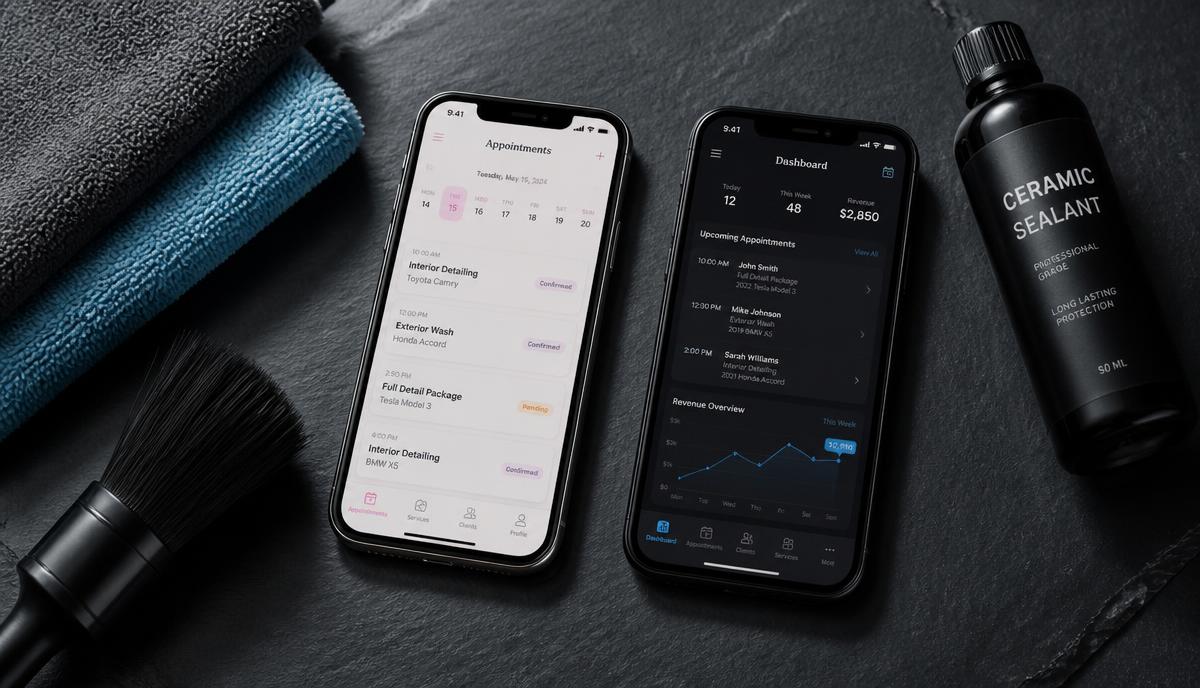
A proper booking system changes the game. Customers can see your services and add-ons, view your real availability, and book themselves in without needing to call you. With online payments, they pay securely at the time of booking. Automated reminder emails and SMS messages keep them informed. Automated cancellation policies drastically reduce no-shows. And you get all of this without lifting a finger.
Automate is built specifically for this. It handles your bookings, payments, reminders, and customer management in one place, so you can focus on the actual work. It makes you and your business look professional and trustworthy, which matters enormously when you are asking someone to hand over the keys to their car.
A booking system is not a luxury for when your business is bigger. It is a foundation that helps you grow from the start.
5. Reviews
This one ties everything together. Active social media tells potential customers that other people are booking you. A good website and booking system tells them you are a serious business. Reviews confirm that all of it is true.
In a market where customers are spoilt for choice, reviews are the tiebreaker. Two valeters with similar pricing and similar services, but one has 85 five-star Google reviews and the other has three? That is not even a contest.
The key is to make review collection a habit, not an afterthought. Ask every single customer to leave a review after their valet. Make it easy for them by sending a direct link. And keep your reviews in one place. Do not scatter them across Google, Facebook, Trustpilot, and half a dozen other platforms. Consolidate them on Google. A strong Google Business Profile with plenty of recent, genuine reviews does more for your local visibility than almost anything else.
Set up a Google Business Profile if you have not already. It is free, and it puts your business on Google Maps and in local search results. Fill it out completely with your services, photos, opening hours, service area, and a link to your website.
Reply to every review you receive, positive or negative. It shows that you are engaged and that you care about customer feedback. And it keeps your profile looking active.
With Automate, review collection can be automated. After every completed booking, the system sends your customer a review link without you having to remember or chase it up. Over time, this builds a bank of genuine reviews that does your selling for you.
Playing the Long Game
The mobile valeting businesses that thrive are not the ones with the fanciest equipment or the lowest prices. They are the ones that get the fundamentals right and stick with them.
Consistency beats everything. Showing up on time, doing quality work, communicating professionally, and building relationships with your customers. These things compound over time. A customer who books you every month is worth far more than a one-off full valet, and they cost you nothing to acquire after that first booking.
Retention is where the real money is. Existing customers are assets. Every time you turn a new customer into a repeat booking, you reduce your dependence on advertising and word-of-mouth to keep your calendar full. Focus on giving people a reason to come back, not just a reason to book once.
The competition will keep growing. Advertising costs will keep rising. New valeters will keep entering the market with cheap prices and a pressure washer in the back of their car. That is the reality of an unregulated, low-barrier industry.
But the ones who last are the ones who build a proper business. A social presence that shows they are active and trusted. A website that makes them easy to find. A system for reaching new customers and driving traffic. A booking platform that handles the admin and makes the customer experience seamless. And a growing bank of reviews that proves they deliver on their promises.
Nail those five things, and you will not just start a mobile valeting business. You will build one that lasts.